Search
National Public Safety Telecommunications Council
In-Building Communications
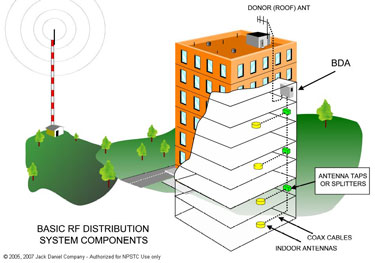
Basic RF Distribution System Components-Copyrighted Jack Daniel Company

For public safety agencies, reliable radio coverage is essential throughout a broad array of public safety jurisdictions, including coverage on the street, in buildings, and in tunnels. The general public often experiences similar needs from the commercial wireless systems they are using. Increasingly, in-building and in-tunnel communications are of key concerns for both public safety agencies and wireless providers since providing reliable coverage in those environments is particularly challenging. However, providing reliable coverage in those environments is particularly challenging and requires knowledge and expertise of the specialized systems designed to meet those needs.

Over the past several years, some jurisdictions have enacted ordinances requiring minimum levels of coverage for public safety communications within new buildings. In addition, the International Code Council (ICC) and the National Fire Protection Association (NFPA) are currently pursuing the adoption of national-level model codes and standards to help ensure that improved in-building coverage is addressed on a nationwide basis.

NPSTC has developed a white paper, Best Practices for In-Building Communications, which can be an important resource for public safety agencies. The white paper, developed by the In-Building Working Group of the NPSTC Technology Committee, covers a number of key topics. These topics include information on various ways to attain in-building coverage, sample local ordinances, national- level code initiatives, the proper design and installation of in-building systems, trade-offs among various technology approaches, interference prevention, regulations, and a summary of best practices. In addition, NPSTC partnered with the In-Building Wireless Alliance (IBWA) which developed and conducted a survey of public safety practitioners on the value proposition of in-building communications. The survey results, reported in the Best Practices paper, address future needs for data and video, as well as current voice requirements.

The Best Practices white paper is available for downloading free of charge from the NPSTC home page at NPSTC.org. The paper, which covers a total of 65 pages, is divided into two files -- the main body and the technical appendices. Those interested in the paper are encouraged to download both files. The paper was developed under the leadership of Stu Overby, Chair of the NPSTC In-Building Working Group and approximately 10 contributors from public safety and industry.

Copyright © 2005-2010. National Public Safety Telecommunications Council (NPSTC). All rights reserved.